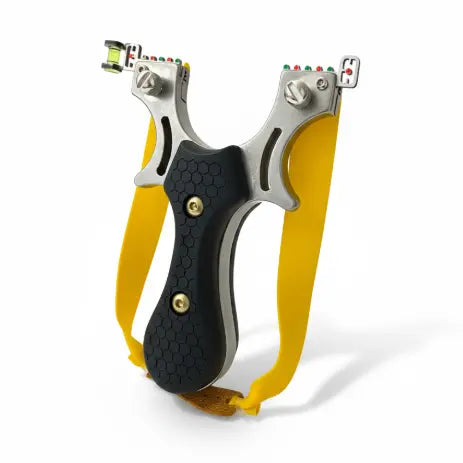
Slingshot Shooting Competitions
Slingshot shooting has evolved from a traditional pastime into a fully competitive sport. The two organizations that coordinate slingshot competitions are:
- The Spanish Sporting Slingshot Association (AETD)
- The World Slingshot Association (WSA)
The first sets dates and coordinates national tournaments, while the second governs the rules and regulations for the different competition formats.
Competition Formats (WSA)
Slingshot shooting has evolved so much that it has branched into several distinct disciplines:
Precision Shooting: The flagship competition. Preliminary rounds are held at 10 meters, with semifinals and finals at 15 meters. Competitors knock down circular targets ranging from large to small within a set number of shots. Scoring is based on targets successfully knocked down.
Traditional Shooting: A discipline where regulations require the slingshot to be entirely handcrafted to specific dimensions, with wood as the primary material.
Frameless: A format where no fork or slingshot frame is used — only the shooter's hands, an elastic band, and a projectile.
Speed Shooting: Competitors knock down a set of targets (typically 5–10) as fast as possible. Only one projectile may be fired at a time, and shooters may fire as many times as they can within the time limit (1 minute) or until all targets are down.
Below are the rules for the two most popular disciplines: Precision Shooting and Speed Shooting.
Precision Shooting Regulations
The Competition Setup
- Official distance: The shooting line is placed exactly 10 meters from the front face of the targets.
- Shooting box: The shooter must remain inside a roughly 1×1 meter box and may not step on the shooting line while firing.
- Target height: The center of the target must be between 1.40 and 1.50 meters above the ground.
Round Format
- Number of shots: A standard competition consists of 30 to 50 scoring shots, divided into ends of 5 shots each.
- Time limit: Shooters have a set amount of time (generally 2–3 minutes) to fire their 5 shots per end. Exceeding the time limit invalidates any remaining shots.
- Practice shots: Before scoring begins, a number of practice shots (normally 5) are allowed to adjust aim and band tension.
Scoring System
Two main methods are used depending on the tournament type:
Ring Targets (Paper):
- A target with 10 concentric rings is used.
- The center (10 points) typically measures 1 cm. Outer rings decrease in value down to 1.
- Line-touch rule: If the ball's impact touches the line between two zones, the higher score is always awarded.
Knock-Down Targets (Plates):
- Suspended metal or resin discs are used.
- Diameters vary to increase difficulty (e.g., 4 cm, 3 cm, 2 cm).
- Scoring: Target knocked down = points awarded. Target that moves but does not fall = 0 points.
Technical Specifications
- Ammunition: Only steel balls are permitted. The most common competition diameter is 8 mm, for its balance of weight and wind resistance.
- The slingshot: Must be held freely by hand. Optical or laser sighting devices are strictly prohibited — only the visual reference of the frame itself or handmade marks on the bands is allowed.
- Bands: Must be made of latex. There is no thickness limit, but they must be safe and in good condition (judges may inspect them).
Fouls and Penalties
- Dry fire: Firing without ammunition (accidentally or as a test) after the start signal may result in a penalty.
- Out of bounds: If a projectile ricochets and strikes another shooter or leaves the range due to misuse, the shooter may be disqualified on safety grounds.
Speed Shooting Regulations
Two main formats exist:
- Fixed Time Format: The shooter has a set time limit (usually 60 seconds) to knock down as many targets as possible.
- Fixed Target Format: A set number of targets (e.g., 5 or 10) are placed, and the time it takes to knock them all down is recorded. The shooter who stops the clock earliest wins.
Field and Target Setup
- Distance: Slightly shorter than in precision shooting, typically 8 or 10 meters.
- Targets: Usually metal discs around 5–8 cm in diameter, mounted on a rack or "house" structure that allows the target to fall or spin when hit.
- Layout: Targets are generally aligned horizontally at the same height (1.40–1.50 m).

This is the most strictly regulated area to prevent unfair advantages:
- Ammunition supply: Steel balls must be kept in a container (box or tray) on a table beside the shooter, or in a magnetic dispenser attached to the slingshot or wrist (if allowed by tournament rules).
- No pre-loading: The shooter must begin with empty hands or holding only the slingshot. The ball may not already be placed in the pouch before the start signal.
- Manual loading: Each projectile must be individually picked up, placed, and fired. Automatic feeding mechanisms are not permitted.
Firing Procedure
- Start signal: A whistle or acoustic signal starts the clock.
- Reloading technique: Shooters typically use a "quick anchor" technique, relying on intuitive alignment rather than careful aiming.
- Finish: When time expires, any ball already released from the pouch after the "cease fire" signal does not count, even if it knocks down a target.
Tiebreaker Rules
If two shooters knock down the same number of targets within the time limit:
- Fewest misses: Balls used are counted (if recorded).
- Sudden death: A 30-second round to determine who knocks down more targets.
Equipment Limitations
- Bands: Thinner or softer bands are typically used compared to precision shooting. While they sacrifice power, they allow faster draw and reduce arm fatigue during high-intensity rounds.
- Pouch: Must be made of a material that allows a clean, fast release of the steel ball.
The Officiating Process — Ensuring Fair Play
In competitive slingshot shooting, the role of the judge or referee is essential for validating each impact and ensuring equal conditions for all competitors. Their work is divided into three phases:
Pre-Competition Technical Inspection ("Equipment Check-In")
Before the competition begins, referees inspect each shooter's equipment:
- Slingshot check: They verify the slingshot has no prohibited wrist or forearm rests and includes no laser sights or electronic aids.
- Band safety: Latex bands are checked for cuts or cracks that could cause dangerous breakage during shooting.
- Standard ammunition: Balls are confirmed to be steel and within the permitted caliber (typically 8–9.5 mm).
Shooting Line Control
During the competition, line judges monitor shooter behavior:
- Foot position: They watch to ensure the shooter does not step on or over the shooting line (foot fault).
- Execution time: In both precision and speed shooting, the referee controls the clock. Any shot fired outside the time window is automatically disqualified.
- Order of fire: Judges coordinate the "Load," "Fire," and "Cease Fire" signals. No one may touch their slingshot until the safety command is given.
Impact Validation and Scoring
This is the most critical phase and is handled differently by discipline:
- Precision (Paper targets): Two judges typically verify each target. If there is doubt about an impact touching the line between two score zones, the advantage rule applies: the shooter always receives the higher score.
- Speed Shooting: Judges use manual counters (click counters) to record each knocked-down target in real time. In major finals, video review is used if there is a protest about whether the ball left the pouch before or after the cease-fire signal.
Handling Protests
Official tournaments have a Competition Committee. If a shooter disagrees with a judge's scoring decision, they may file a formal protest. The jury reviews the impact (or video footage) and their decision is final.
Sportsmanship
Beyond the rules, slingshot sport officiating places heavy emphasis on absolute silence while a fellow competitor is shooting. A referee may formally warn any spectator or competitor who deliberately distracts a shooter at the line.
Tournament Formats
Slingshot competitions also come in different formats:
- Individual competitions: Competitors compete individually across the various disciplines, such as at the Spanish Championship.
- Team competitions: Teams are typically made up of three or four members, with each member's scores combined to determine the winner.
- Open/Popular competitions: These differ in their targets, which may include cans, bowls, or clay plates. Prizes are usually trophies or slingshot-related products.